Zachary
Newmark

Physics student applying quantitative reasoning to investing, corporate development, and scientific research.
Currently: Blockchain Development Apprentice at Lindenshore · Syracuse University Class of 2028
Selected Work
M&A Target Sourcing
A structured sourcing process that narrowed a universe of approximately 2,000 SaaS businesses down to an actionable acquisition pipeline.

WashU Medicine Lab Research
Research at WashU Medicine under Dr. DiAntonio, testing whether E. coli TIR domains share the NAD-cleaving enzymatic activity discovered in SARM1.

Rocket Lab Investment Thesis
An event-driven investment thesis focused on the market's anticipation of Rocket Lab's Neutron development milestones.
I'm a junior at Syracuse University studying Physics with a Finance minor. My academic interests span quantitative reasoning and capital markets — I'm drawn to problems that require both rigorous analysis and sound judgment about whether a company's fundamentals support its stated strategic goals.
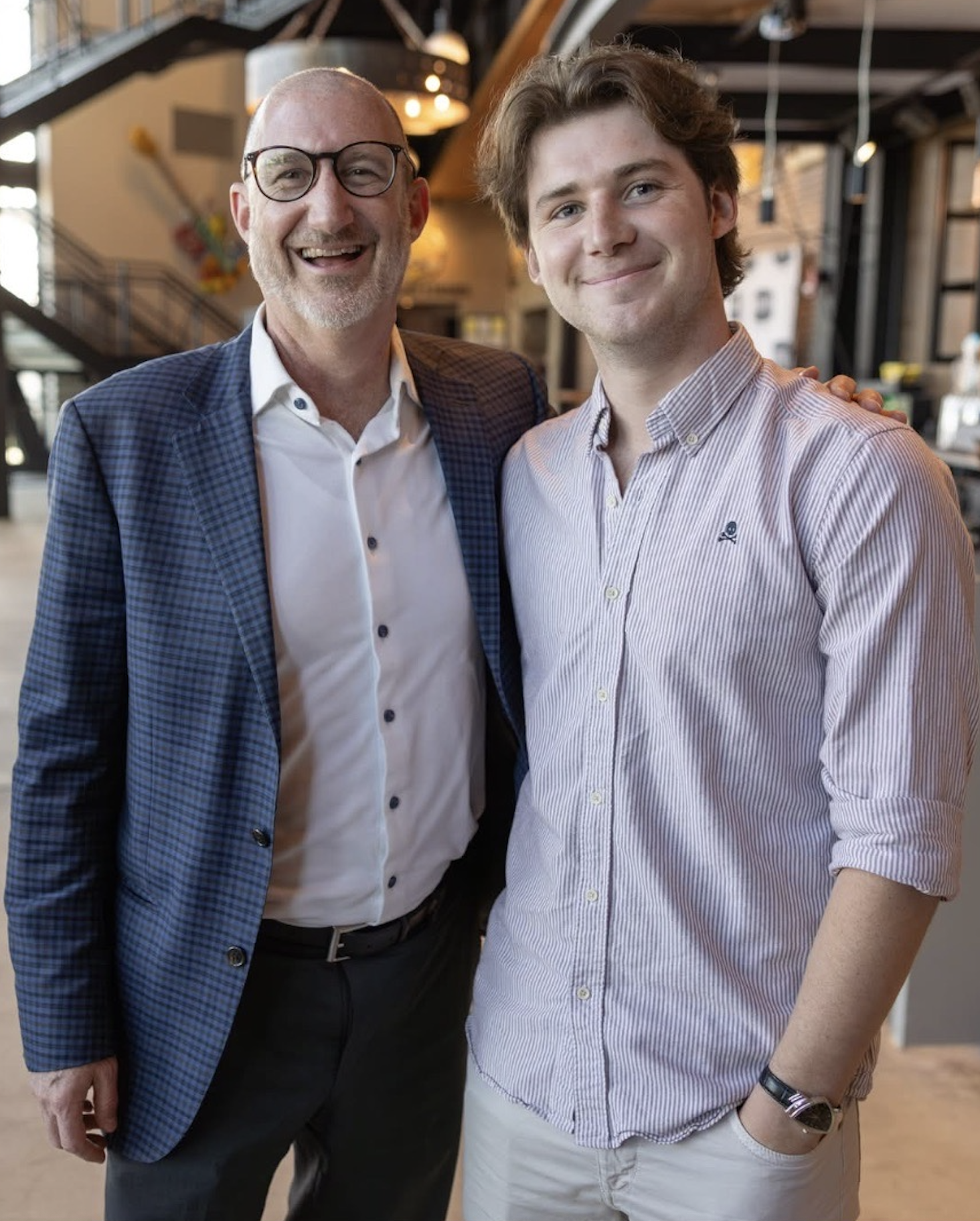
Currently, I'm a Blockchain Development Apprentice at Lindenshore, doing mentored, project-based work on Uniswap V2 liquidity pools, crypto trading, and arbitrage. Before that I spent a year as a Corporate Development Analyst Intern at Capacity, where I sourced and evaluated potential acquisition targets. Outside of coursework and internships, I spend time on investment research and running student organizations.
When I'm not working or studying, you'll usually find me outside: backpacking with friends, training for an Ironman, scuba diving, skiing, or playing golf. I'm also working my way through the Dune trilogy. One of my long-term goals is to visit every country in the world.
Corporate Development
M&A Target Sourcing · Capacity
Overview
As a Corporate Development Analyst Intern, part of my role was sourcing and filtering acquisition targets from large, unstructured datasets down to an actionable pipeline.
Objective
Map a large unstructured universe of SaaS companies down to a diligence-ready pipeline of acquisition targets aligned with strategic criteria.
Process & Funnel
Master List Intake
Started with a raw universe of ~2,000 SaaS companies.
Revenue Filtering
Sorted and filtered by revenue to isolate companies within the target acquisition range.
Criteria Screening
Manually reviewed each remaining company against sourcing criteria (software category, product fit).
First-Pass Shortlist
Flagged qualifying companies for deeper commercial diligence by the team.
Execution
Tools Used
Evaluation Criteria
- Software category and product fit
- Revenue range alignment
- Customer profile
- Market position
Deliverable
A prioritized first-pass shortlist of qualifying companies flagged for deeper commercial diligence by the senior team.
What I Learned
The challenge was not simply finding companies, but consistently distinguishing strategic fit across product category, customer profile, market position, and acquisition criteria.
Research
TIR Domain NAD-Cleavage · Washington University School of Medicine
Research Lab headed by Dr. Aaron DiAntonio — Washington University School of Medicine
Background
I worked at the Washington University School of Medicine Research Lab headed by Dr. Aaron DiAntonio — one of the leading figures in Alzheimer's research. Working directly with Dr. DiAntonio and his team, I was part of a lab known for a landmark discovery: that SARM1 could cleave NAD via a TIR domain. This was a significant breakthrough, as TIR domains had previously been understood only as signaling proteins, not enzymes. Dr. DiAntonio is regarded as one of the leaders in this area of work.
Building on that foundational discovery, I set out to test whether other TIR domains — this time in E. coli — shared the same NAD-cleaving ability first identified in SARM1.
Research Question: "Do other TIR domains in E. coli share the NAD-cleaving enzymatic activity first identified in SARM1?"
Methodology
Initial Method
My initial method used 24-well plates, testing roughly 30 different TIR domains in E. coli (each in triplicate, to guard against experimental noise). By shining light through each well and measuring opacity over time, I could track bacterial population growth — the idea being that a TIR domain actively cleaving NAD would be toxic enough to suppress or kill the population, showing up as a change in growth rate.
Even so, this method surfaced 3 TIR domains that looked like promising candidates worth investigating further.
Experimental Limitation
The method had a fundamental limitation: since each well could only support a finite population size, a TIR domain that killed bacteria slowly produced a final readout that looked nearly identical to a well that simply grew normally and plateaued. The opacity converged either way — only the timing differed, and that timing signal wasn't reliable enough to separate a "toxic but slow" TIR domain from a normal one.
Methodological Pivot
Rather than treating the ambiguous data as a dead end, I shifted to a harder but more direct method: measuring the actual metabolic byproducts of NAD cleavage rather than inferring it indirectly through growth. I tested the 3 candidate TIR domains alongside a known negative control, sampling at 4 and 8 hours to track metabolite levels directly.
Result
This approach isolated one TIR domain that showed a genuinely promising signal for NAD-cleaving activity — the point at which I presented my findings to Dr. DiAntonio and the lab's graduate students.
Retrospective
Core Takeaway
I learned to recognize when an experimental method had a structural blind spot and to redesign the approach rather than force conclusions from ambiguous data.
Investment Research
Rocket Lab (RKLB) — Long Thesis, April–May 2026
Overview
Investment Question: "Would the market price in Neutron development milestones ahead of the test date, regardless of the outcome?"
Setup
On traditional valuation metrics, Rocket Lab looked expensive — the stock's P/E ratio was deeply negative, reflecting an unprofitable company. But we argued the market was mispricing Rocket Lab by focusing on trailing earnings rather than the transformative potential of Neutron, its next-generation reusable rocket.
Thesis
Rocket Lab was preparing for a major Neutron test, expected that summer — a milestone we believed the market would price in ahead of time, regardless of the eventual outcome. If the test succeeded, Rocket Lab would be positioned for expanded government and defense contracts, unlocking a durable, high-margin revenue stream. If the test failed, the company would face real financial strain — but by then, the stock would likely have already priced in the anticipation, rewarding investors who got in early and exited before the actual event.
Risks & Catalysts
Key Catalysts
- Upcoming Neutron structural test — expected summer 2026
- Anticipatory positioning by institutional investors ahead of milestones
- Potential expanded government/defense contracts on success
Major Risks
- Test failure or delay removing the anticipatory premium
- Broader market selloff compressing risk-on names
- Holding through the test itself (binary outcome)
The Trade
Trade Construction
Rather than holding through the test itself — a binary, high-risk event — we built a position ahead of the anticipated test window and planned to exit before the actual test date, capturing the hype-driven run-up without carrying the outcome risk.
Exit Rationale
"Planned exit before the actual test date to avoid carrying binary outcome risk."
Outcome
Execution & Result
Presented for educational and portfolio purposes. This is not investment advice.
RKLB Anticipatory Run-up
Source: S&P Global Market Intelligence · Apr–Jul 2026
Retrospective
How It Played Out
The Neutron test itself ended up slipping to later in 2026 due to technical issues uncovered during testing. That delay validated the core risk we identified — but by exiting ahead of the actual test date rather than holding through it, the position captured the anticipatory rally without being exposed to that setback.
What I Learned
Event-driven positioning requires being precise about what the market is pricing in and what you're not willing to be exposed to. Getting in early and out before the binary event is a different skill than identifying the thesis.
Leadership
Clayton Spirit
Overview
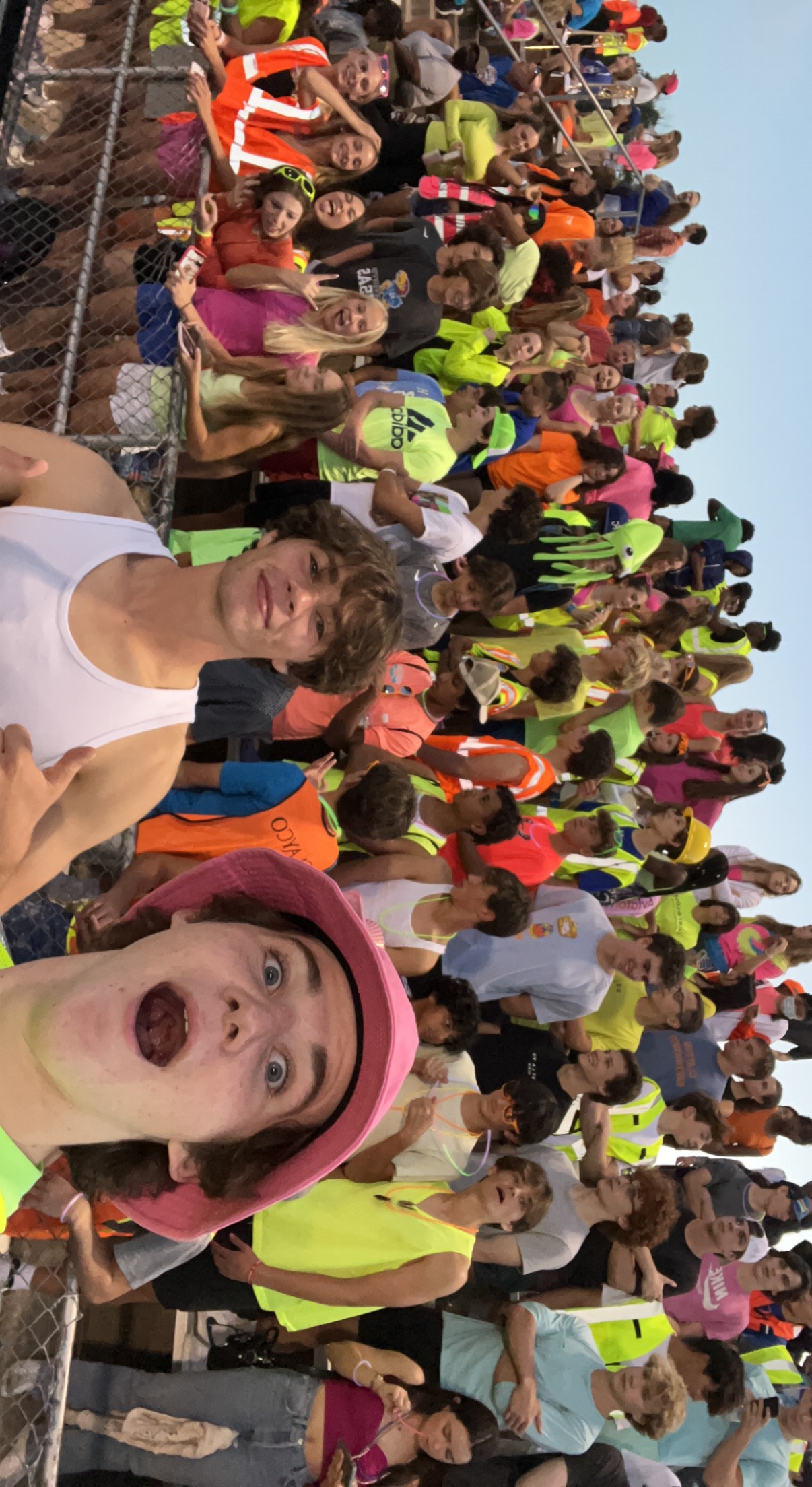
During my junior year of high school, a friend and I co-founded Clayton Spirit, a student-led organization that created themes, events, and fundraising initiatives around Clayton High School athletic games. The initiative grew fan attendance from tens of students to hundreds. During my senior year, while serving as Senior Class President, I led fundraising efforts that helped raise more than $8,000 for student activities. More than four years later, Clayton Spirit remains active.
Timeline
Junior year of high school: Co-founded Clayton Spirit
First season: Fan attendance grew from tens to hundreds of students
Senior year: Served as Senior Class President and led fundraising efforts that raised more than $8,000 for student activities
Present: Clayton Spirit remains active more than four years later
My Role
My responsibilities included co-founding the organization, planning and coordinating game-day themes, organizing fundraising efforts, managing group logistics, working with school administration, and leading broader student initiatives while serving as Senior Class President.
Building
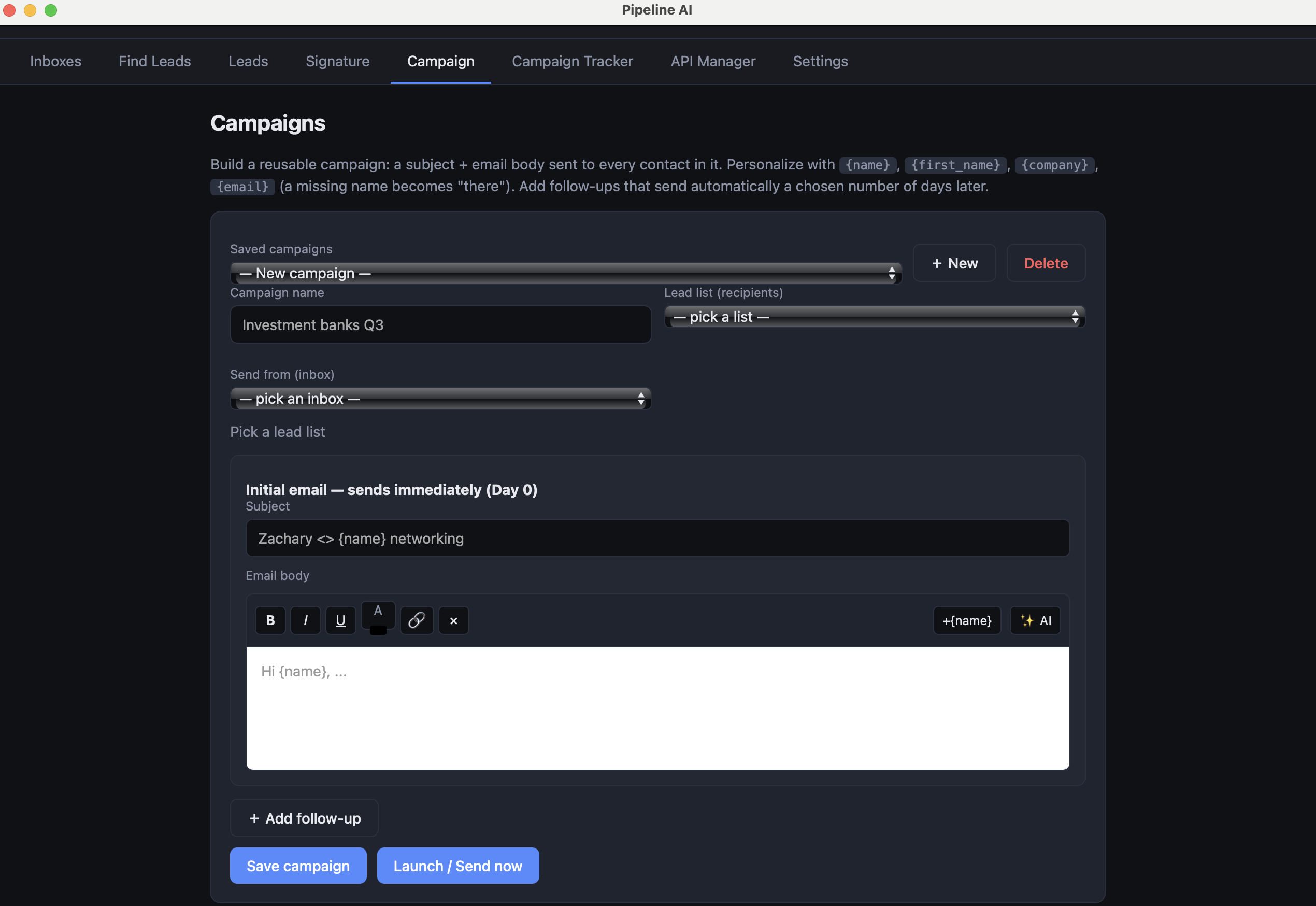
Outbound Campaign Platform
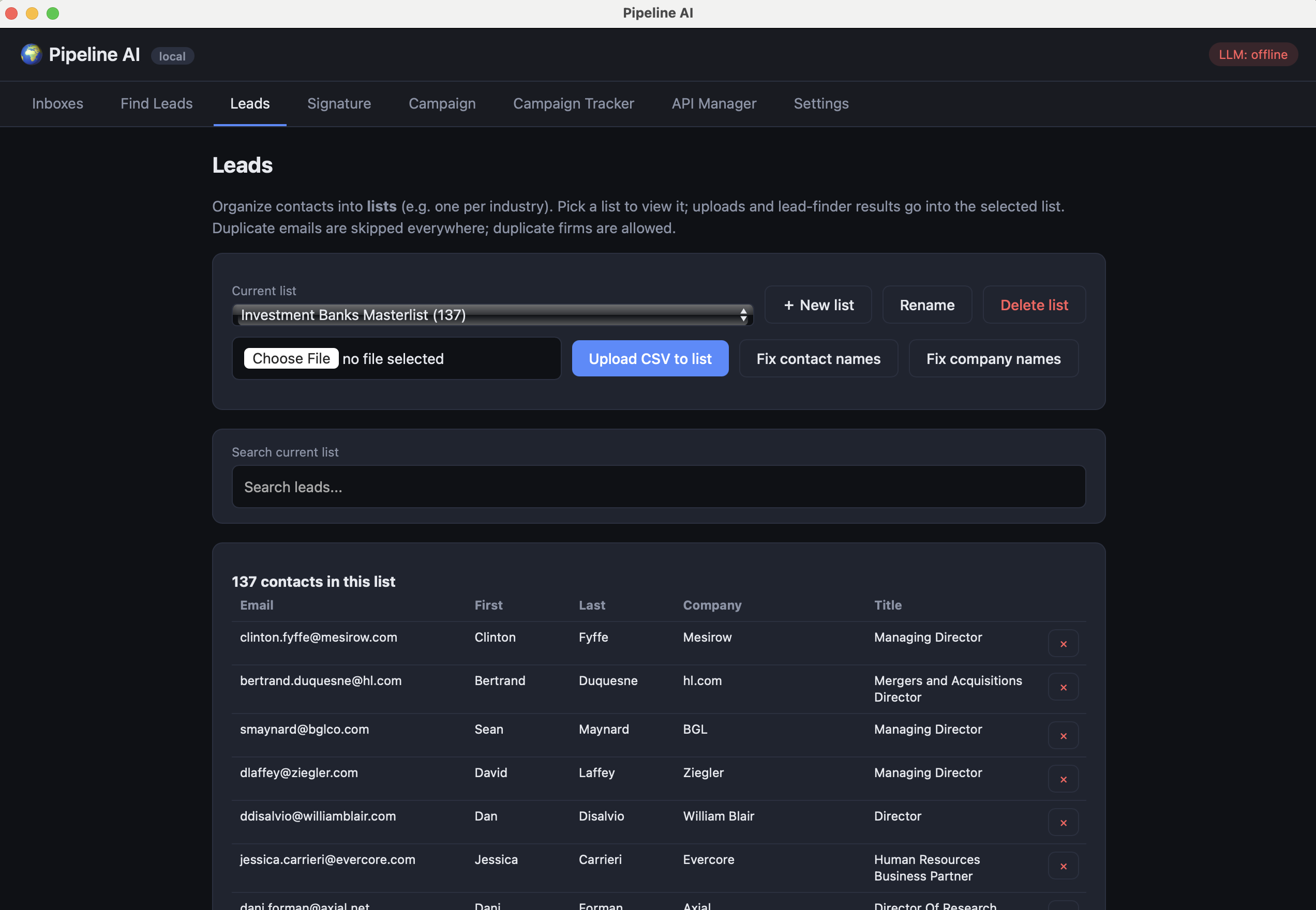
Built a local application for lead sourcing, campaign management, automated follow-ups, API management, and email-delivery tracking.
Problem
Managing outbound campaigns across multiple tools created fragmented workflows, inconsistent follow-up, and poor tracking.
Product
A single local application consolidating lead management, campaign sequencing, and delivery tracking.
Core Features
- Lead sourcing and organization
- Campaign management and scheduling
- Automated follow-up sequences
- API integration management
- Email delivery tracking and reporting
Technical Decisions
Built with Python and a local SQLite database, using a custom-built UI for campaign orchestration and a REST API layer for managing integrations with email delivery providers.
Lessons Learned
Building a purpose-built tool for a specific workflow teaches you to prioritize ruthlessly — every feature either solves a real friction or doesn't get built.
Skills
Research
Finance
Tools
Building
Zach at a Glance
Academic
Leadership & Awards
Professional Skills
Contact
I'm always interested in conversations about investing, corporate development, scientific research, and early-career opportunities.